The Exploration Continues - In Search for a Future in the WASH Sector
A Market-driven approach to sanitation - two case studies
The bottom-of-the-pyramid (BoP) business approach targets the most impoverished population and has reconfigured and internalised a close relationship between the chase for profits and WASH objectives. Recognising the market potential of soap in impoverished communities, Unilever has used its marketing and consumer behaviour expertise to successfully increase handwashing and soap usage (Hopkinson, 2017). Handwashing reduces human contact with waste and germs, which prevents the transmission of diarrheal and other diseases (Burton et al. 2011). This reconfiguration might address the concern of and put less pressure on regulatory bodies to address the potential imbalance between profitability and WASH objectives, as in the case of PPP. However, there are still potential risks in businesses' power and profit-oriented behaviour, especially for TNCs like Unilever; one example is the inclusion of triclosan, a scientifically controversial agent in Unilever soap (Cross & Street, 2009).
In Nairobi, Kenya, Sanergy has invented a BoP sanitary system. Sanergy takes charge of constructing and installing a cluster of toilets within informal settlements, marketing the toilets, charging users, and collecting excreta safely daily. These excreta are transformed into organic fertilisers that can be sold on the market. The toilet properties are then sold to local entrepreneurs. There are over 600 toilets in Nairobi. They possess better hygiene than regular toilets, particularly with a handwashing facility fitted around each of them (O'Keefe et al., 2015). In addition to the same advantages as PPP, such as efficiency, a market-led BOP approach has other strengths, as demonstrated by the Sanergy case. The unique focus at BoP fosters innovations, bringing new complementary WASH solutions. Similar BoP WASH initiatives exist, including Vestergaard's water filtering tools. Accountability is introduced within the firms that wish to grow. Additionally, this focus and resulting affordable prices together remove the risk of selective provision of WASH services in the PPP case. Besides, there is a possibility for financial sustainability. However, scalability challenges exist, mainly in finances and convincing more residents to use the good/service. Governments still play a role in encouraging BoP initiatives and helping to combat these challenges (O'Keefe et al., 2015).
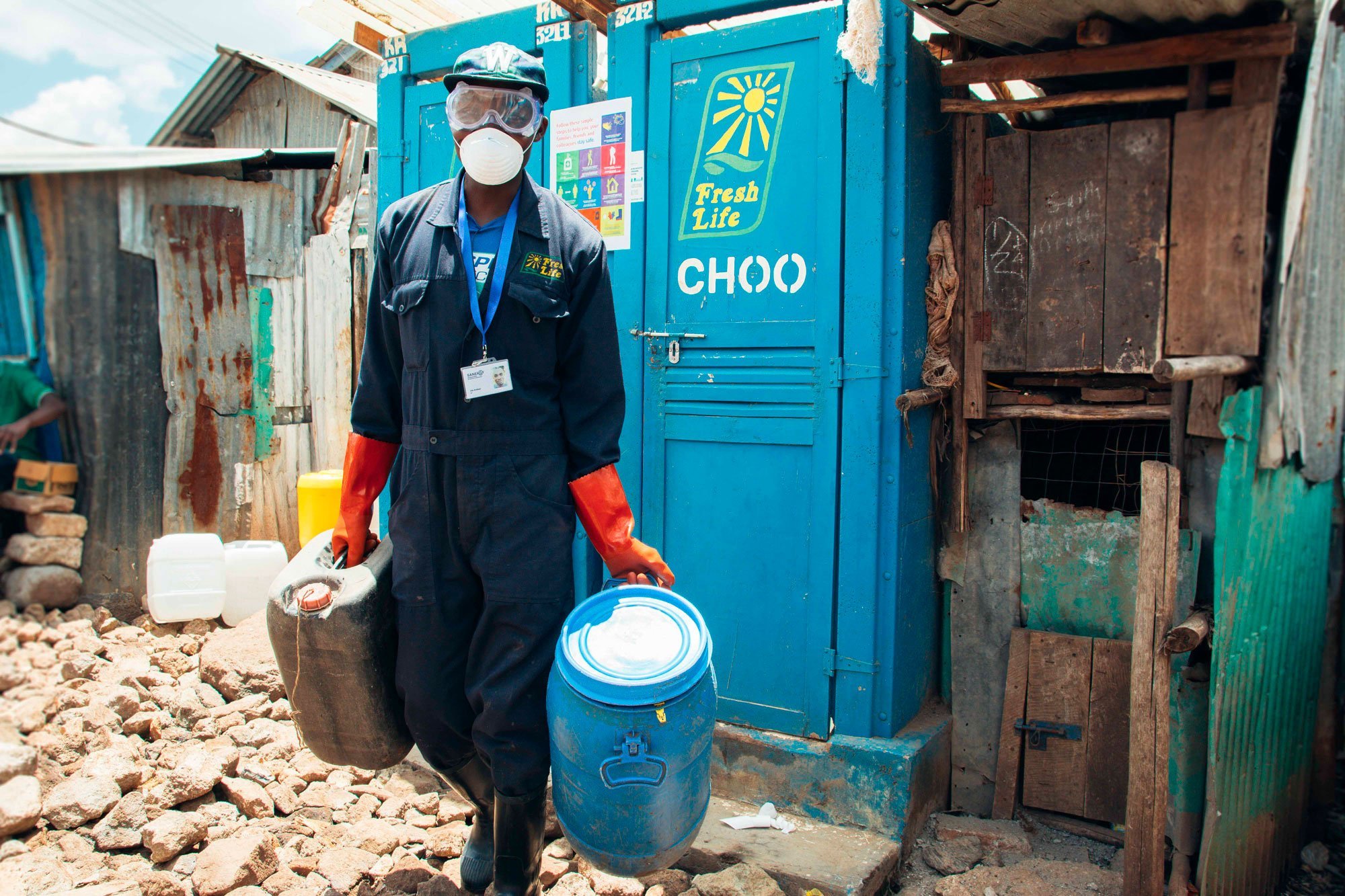 |
Fig.1: A Sanergy toilet. |
Concluding Comments
Bottom-up techniques, community management, private-sector participation, and market-driven approaches represent different actors' on-going efforts in search for a WASH solution. No perfect solution exists; we must scrutinise each physical and human context to design the appropriate formula. However, a common theme wanders about, that is the indispensable role of governments and public sectors. They must support wide formal capacity building, research, cooperation, etc. (Gaye & Tindimugaya, 2019). We may need to refocus on them for institutional improvements, which may require radical reforms. We also need to pay attention to the general socio-economic growth and development, which positively correlates with better WASH conditions (Hutchings et al., 2015).
Here, we approach the end of this blog. I would like to thank all of you who joined me on this journey and those who supported me.


Hi Lucas, really enjoyed your blog! I also write about sanitation in Nairobi and the fresh life toilet initiative. Acceptance from the local community is definitely a key to promoting fresh life toilets. I'm curious about what do you think the local communities, sanitation practitioners, or governments could do to overcome the scalability challenges you mentioned?
ReplyDeleteHi Yanya, thanks for following my blog and raising this question! The market-led approach, as an explorative approach, required further research. From my point of view, I think there needs to be continuous dialogue, market research, innovative marketing, or some other mechanisms between the sanitation practitioners and the communities to ensure a demand-responsive approach (DRA) instead of a supply-driven approach. This means that the WASH goods/services provided are really demanded by the communities but not imposed on them, enhancing community acceptance and scalability potential. Check out this paper: https://www.ircwash.org/sites/default/files/trends_in_rural_water_supply_-_towards_a_service_delivery.pdf. From a government's point of view, they should provide essential support to encourage innovation of new methods of water and sanitation, such as relaxed regulatory environments, and coordination of the communication between sanitation practitioners and local communities.
DeleteI enjoyed reading your blog and gained insights into the topic of water and sanitation. Given my focus on writing about water and food, I wish to expand my knowledge in these domains. I am interested in exploring the relationship between sanitation and food. I believe that inadequate sanitation practices like having dirty hands, may pose a significant risk of contaminating food during preparation, potentially contributing to food insecurity. Looking forward to hearing your thoughts!
ReplyDeleteHi Tianle,
DeleteThe relationship between sanitation and food security is multifaceted and crucial. Poor sanitation practices can lead to food contamination, particularly when unclean hands are involved in food preparation or when contaminated water is used in cooking, posing significant health risks. Additionally, polluted water from inadequate sanitation can harm agricultural productivity, as crops irrigated with such water can absorb harmful substances. Innovative approaches like converting waste into fertilizer, as seen in the Sanergy project in Nairobi, demonstrate how improved sanitation can positively impact food production and safety. Therefore, ensuring proper sanitation is vital not only for public health but also for maintaining a safe and nutritious food supply, underpinning broader food security goals.
Hi Lucas,
ReplyDeleteI really enjoyed reading your blogs and I've learnt alot from it. Regarding these market-based approaches, what's your take on the issue of TNCs, like Unilever, having potentially conflicting interests is critical. How can ethical concerns be addressed while harnessing their resources and expertise?
Hi Damien,
DeleteThank you for your kind words and interest in my blogs! You raise an important and complex question regarding the role of Transnational Corporations (TNCs) like Unilever in market-based approaches to WASH (Water, Sanitation, and Hygiene) issues.
TNCs often possess significant resources, expertise, and global reach, making them potentially powerful allies in addressing WASH challenges. However, as you correctly point out, their involvement can raise ethical concerns due to potential conflicts between profit motives and public health goals. Here's how these concerns can be addressed while still harnessing the resources and expertise of TNCs:
1. Transparency and Accountability: TNCs should be transparent about their intentions, strategies, and the ingredients or processes used in their products or services. This includes openly discussing potential conflicts of interest. Establishing clear mechanisms for accountability can help ensure that their actions align with public health and ethical standards.
2. Regulatory Oversight: Governments and international bodies play a crucial role in setting and enforcing standards that balance profit motives with public health goals. Regulations can guide TNCs to operate within ethical boundaries, ensuring that their practices do not undermine public health or environmental sustainability.
3. Public-Private Partnerships (PPPs): Collaborations between TNCs, governments, and non-governmental organizations can leverage the strengths of each sector. In PPPs, the public sector can provide oversight and ensure that the initiatives serve the public interest, while TNCs can contribute their resources and expertise.
4. Community Engagement and Empowerment: Ensuring that local communities are involved in decision-making processes can help align TNC initiatives with the actual needs and preferences of the people they are intended to serve. This approach can mitigate the risk of imposing solutions that are not culturally or contextually appropriate.
Hi Lucas,
ReplyDeleteReaching to the end of your blog series, I get to learn CM, PSP, and Market-based approaches as the potential solutions to mitigating WASH scarcity and insanitation. Out of the three approaches, which one do you think is most sustainable?
Hi Yiyi,
DeleteIn my view, the most sustainable approach is likely a hybrid or integrated model that combines elements of all three approaches, as highlighted in this paper (https://www.tandfonline.com/doi/full/10.1080/07900627.2017.1423282):
1. Integration of CM and PSP: In some cases, a blend of community ownership with private sector efficiency can work well. Communities can manage day-to-day operations while private entities handle more complex infrastructure and technical challenges.
2. Market-Based Approaches with Social Goals: Aligning market mechanisms with social objectives can ensure that WASH services are both financially sustainable and accessible to lower-income groups. This might involve innovative financing models, subsidies for the poor, or public-private partnerships.
3. Government Oversight and Support: Regardless of the approach, government involvement is crucial in providing regulatory oversight, ensuring equitable access, and supporting marginalized communities.
I've read your blog post on public-public partnership as well, which is really inspiring. There should definitely be cooperation between organisations and the government as well!