Starting from the Reality – Bottom-up WASH Techniques
This post wishes to provide an interesting account of some widely used bottom-up WASH techniques in Africa. Due to government failures in public WASH service provision, these techniques present a compromised yet essential WASH solution. Understanding these techniques allows later exploration of their weaknesses, potential improvements, and complementary solutions for successful WASH improvements.
Water-accessing techniques
Without adequate piped water supply, hand-dug wells, which citizens themselves can construct and operate at low costs, are a traditional and common water-accessing technique. The water in the well can be extracted using a pulley device or, preferably, a sealed handpump. A proper structure that prevents the seeping of surface water and filters silt and sand, illustrated by fig.1, can ensure water safety.
 |
| Fig.1: The structure of a hand-dug well. |
Comparably, despite moderately higher construction and operation costs, boreholes equipped standardly with a handpump provide a safer yet “man-powered and low-technology” technique. They are constructed with a drilling machine and feature better sealing and greater depths to reach higher-quality deeper aquifers (fig.2). Each borehole or hand-dug well fitted with a handpump is capable of serving the needs of 300 people (MacAllister et al., 2022).
 |
Fig.2: The structure of a borehole. |
I want to encourage reading this article by WaterAid, which provides a detailed account of rainwater harvesting, spring protection, subsurface dams and other bottom-up water-supply techniques that I cannot explore here.
Sanitation techniques
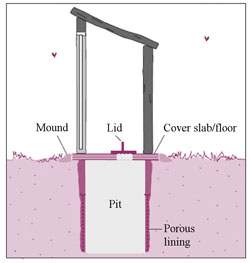
In the absence of proper toilets and sewage networks, pit latrines (fig.3) provide affordable, easy-to-build, and acceptable (at least compared with open defecation) sanitation. On average, 65% of the African population was reported to rely on in-situ sanitation, mainly pit latrines (Tuinhof et al., 2017), with the number being higher in rural, peri-urban, and informal urban settlements. Following certain guidelines, including a depth of 3 metres, a location above the water table and more than 50 metres away from well or borehole, faecal wastes can be disposed of and degraded in relative safety.
 |
Water storage and treatment technique
 |
Fig.4: Common water containers. |
Without modern WASH services for many Africans, the reality is the adoption of these bottom-up WASH techniques. I would like to briefly highlight that the adoption of these techniques is context-specific. For instance, fig.5 demonstrates the groundwater depth in Africa (BGS, 2011). While hand-dug wells may work for aquifers up to 25 metres below ground levels (mbgl), boreholes are required where aquifers are deeper.
 |
| Fig.5: Depth to groundwater in Africa. |
Do these techniques always perform appropriately? They don't for many reasons, raising or continuing WASH concerns, which I will explore in my next post with a case study.


Hi Lucas, it's very helpful to know various types of WASH facilities. Looking forward to more in your next post!
ReplyDeleteHi Nia, seeing you join me to explore Africa's WASH nexus is great. As mentioned in my post, these facilities do not often work adequately and satisfactorily. I will demonstrate this with the case study of Lukaya, a small town in Uganda, in my third post, and possible improvements and complementary solutions in the upcoming posts.
DeleteHi Lucas, thanks for introduce these bottom-up approaches of local Africans. What's your opinion on these methods to enhance the sanitation and water scarcity situation for the future? Do you think those facilities can sustain a long term change in local?
ReplyDeleteHello Angel,
DeleteThank you for your input. In my opinion, bottom-up methods could be a sustainable WASH solutions when effectively managed. However, as I’ll explore in my upcoming post, in reality, these methods often suffer from poor management. It is also important to recognise that Africa is a diverse continent. While these approches have a greater chance to sustain in rural settings, their applicability in densely populated urban areas poses significant challenges. Furthermore, I want to emphasise that these bottom-up methods are compromise solution in the absence of hard infrastructure. Ultimately, I believe it's essential that the people of Africa have access to this hard infrastructure. Overall, the key to sustainability is to look for a mechanism to adequately manage these bottom-up methods, to investigate if and how they can applied in diverse African environments, and not give up the efforts to build capability to provide hard infrastructure.
Hi Lucas,
ReplyDeleteIt's great you’ve highlighted various bottom-up WASH techniques. In my opinion bottom up is certainly an effective scheme for local development. But how do cultural factors influence the acceptance and effective use of these techniques in different African communities?
Hi Damien,
DeleteThanks for commenting! In answering your question, I would like to raise three points. Firstly, cultural norms regarding community decision-making and leadership can affect how well communities come together to aceept, support, and maintain WASH facilities. I will disucss community-based management in a later blogpost. Secondly, in reading Yiyi's excellent blog on water and gender (https://zczl446-water-gender.blogspot.com), I realised that in many African cultures, females are often responsible for distant and time-consuming water collection. Additonally, going to shared lartines during night can be dangerous for females. Therefore, to increase the efficiency of bottom-up techniques, it is important to involve females in discussions, and the design and operations of WASH facilities need to take female roles into account. Thirdly, different cultures might have different attitudes towards and practices in WASH, and perhaps education is needed to raise their awareness of WASH conditions.
Hi Lucas,
ReplyDeleteThis post provides interesting and wide accounts of potential sanitation and water-accessing solutions for Africa. I understand that pit latrine, even though is not the best solution, as it also creates a series of potential infectious disease, however, is probably the potential suitable solution under Africa context considering its accessibility and affordability.
As my blogs centre on the water-gender nexus in Africa, so techniques are not my central focus. Therefore, I really learn a lot from your blogs. I am wondering would you recommend the wide spread of pit latrine? What are the pros and cons?
Hi Yiyi,
DeleteThanks for commenting. Please see my next blog, which explains in detail some challenges pit latrines pose, especially groundwater pollution. I think that one of the main pros is that pit latrines are affordable and require low technology to construct and operate. I would recommend the use of pit latrines in rural settings, but need to ensure that they possess proper structure and management. In urban settings, pit latrines may not be a good option due to constrained space. In my final blog, I explored a market-led sanitation service offered by Sanergy, which cleans the toilets daily and transform the waste into fertilisers, which have the potential of resolving the constrained space issue!