Underperformance of Bottom-up WASH Services - Insights from Lukaya, Uganda
This third post will discuss the reliance on and underperformance of bottom-up WASH services.
Fig.1: Locationing Lukaya.
Lukaya is a small town in Uganda (fig.1) that has experienced rapid population growth. Lukaya's WASH services heavily rely upon bottom-up techniques - 95% of its households use on-site sanitation facilities, primarily pit latrines, and almost all households (>99%) use on-site water supply, primarily hand-dug wells (Nayebare et al. 2020).
Underperformance of water services
 |
Fig.2: The 2017 JMP water service ladder. |
According to the JMP standard (fig.2), none of the water services are safely managed, 10% are unimproved, and 33% are limited due to waiting times over 30 minutes - on average, 92 households share each of the 66 water facilities. Not reflected by using the JMP standard, water storage in open containers positioned on the floor by many households risks contamination (Mellor et al., 2014). Current water services have not adequately guaranteed clean water access (Nayebare et al. 2020).
Underperformance of sanitary services
 |
Similarly, based on the JMP classification (fig.3), 51% of the sanitation services are unimproved in the form of pit latrines without a slab (fig.4), and 26% are limited, with each shared by more than 3 households. Moreover, emptying filled pits remains a manual operation and requires digging new pits, which is challenging in densely populated wards with constrained space. Some pit latrines are left with an outlet to allow natural flushing during rainy seasons (Nayebare et al., 2020). Additionally, I suggest we look beyond JMP's sanitation focus on "toilets"; bottom-up techniques have not provided a solution to managing household wastes, including greywater and organic matter (Carter et al., 1999), which are thus littered around (fig.5). Therefore, existing sanitation services have not adequately mitigated unsanitary conditions (Mazeau et al., 2012).
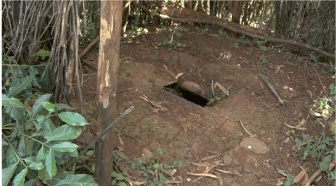 |
Fig.4: A pit latrine without slab. |
 |
Fig.5: Littering. |
Interactions between WASH services
Using the subsurface for excrement disposal and the capture and mixture of wastes by surface runoffs and flood water contaminate the vulnerable shallow groundwater (0.5-5 mbgl), the main water source. Structural flaws or deterioration, e.g., "loose nuts and leaking standpipes", exaggerate this issue. High water acidity and turbidity, excessive nitrate concentration (>10 mg/L), and the existence of Escherichia coli (>103 cfc/100 mL) are evident. Additionally, the water supply's on-site nature restricts hygiene practices, including handwashing. The health consequences are high incidences of malaria and diarrhoea (Nayebare et al., 2020). Hence, the sanitary services have deteriorated the water services, and both have perpetuated poor hygiene and health conditions.
Challenges and opportunities
Two inseparable paths lie beyond. The first is to improve the bottom-up WASH systems, which have limited capacity but constitute, at least temporarily, a realistic solution. Communities and the development sector are the main players. The second is hard infrastructure provision, involving governments and public and private sectors. The challenges are to address inadequacies in investment and provision, capacity building and research, management, planning, monitoring, and maintenance, policy and legal frameworks, and an integrated approach (Gaye & Tindimugaya, 2018).


Hi Lucas, that's really great to see a detailed case study of bottom-up WASH system in Lukaya. Wish to see more discussion on the interaction between WASH services, and maybe can widely applied to other African region.
ReplyDeleteHi Angel,
DeleteThanks for your continuous participation in communicating with me, which has been really helpful to me. Yes, the underperformance of bottom-up WASH systems, and how the underperformance of one WASH service can negative affect another, is not a unique case.
Here is a similar case study of Kampala, Uganda (https://www.sciencedirect.com/science/article/pii/S019739751500140X). The introduction part summarises evidence from across Africa.
Hi Lucas,
ReplyDeleteThis blog post reveals the existing reality of WASH facilities in Africa. By providing an interest accounts of the current conditions of WASH services using explanatory tables, I feel it is easy to grasp the central idea.
My question is: Are there any potential solutions to improve this unsanitary condition? What method do you think will work?
Hi Yiyi,
DeleteI am glad that my blog post is useful to you! Starting from my next blog, I will be discussing about some of the approaches in improving the underperformance of WASH services, including community-based management and private-sector participation. However, I cannot give a certain answer of which methods work and which methods do not, which will really depend on the local context and other factors.